
What is Generative AI?
Introduction
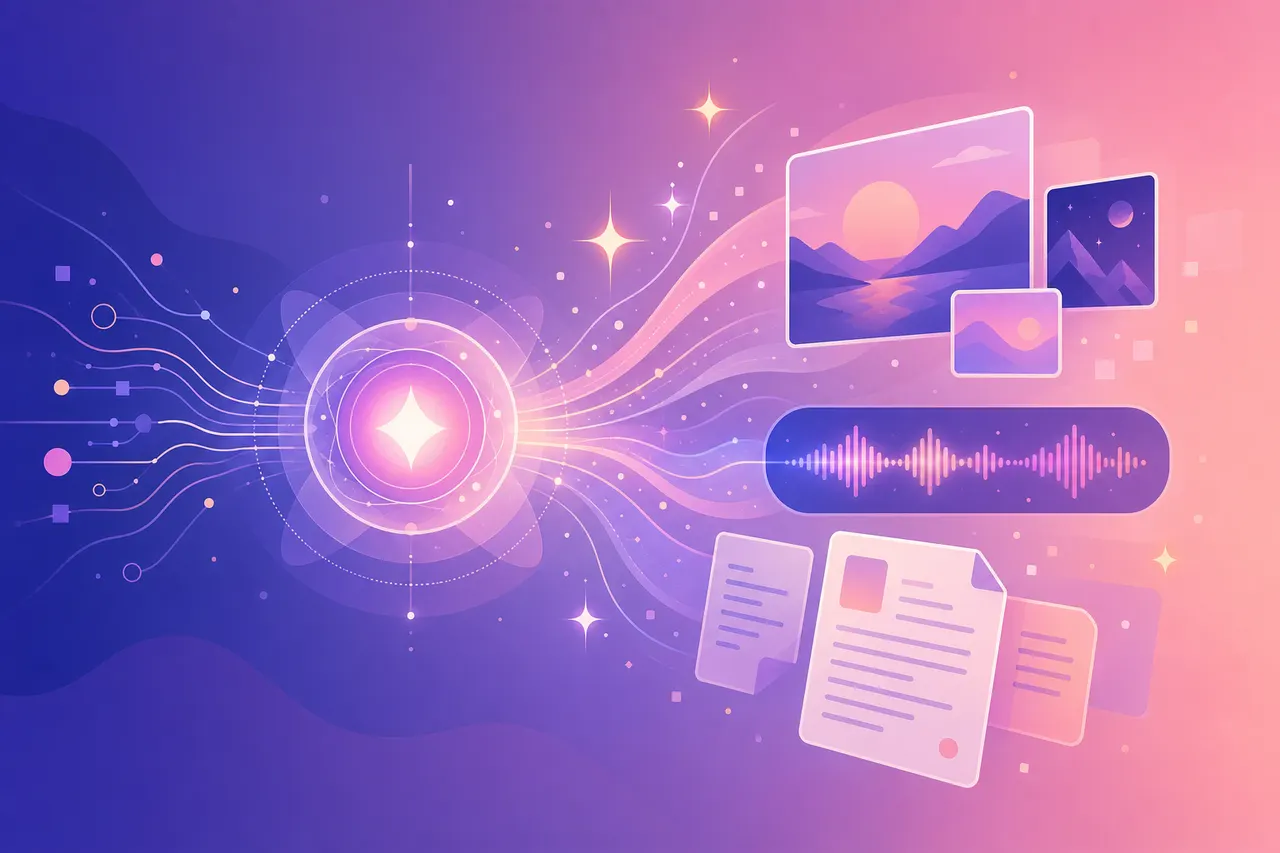
Generative AI is a class of models that create new content, including text, images, audio, video, and code, rather than only classifying or predicting from existing data. These models learn the patterns and structure of their training data and then generate novel outputs that resemble it. The rise of large language and diffusion models has made generative AI one of the most transformative technologies in software.
Definition
Generative AI refers to artificial intelligence systems that can create new content, including text, images, music, and code, based on patterns learned from training data. Unlike traditional AI that classifies or predicts, generative AI creates novel outputs.
Types
Text Generation
AI models that can write human-like text, from short responses to long-form content. Examples include GPT, BERT, and Claude models.
Image Generation
Systems that can create, edit, and modify images based on text descriptions. Examples include DALL-E, Midjourney, and Stable Diffusion.
Audio Generation
AI that can create music, speech, and sound effects. Examples include Whisper, MusicLM, and AudioCraft.
Code Generation
Models that can write and suggest code based on natural language descriptions. Examples include GitHub Copilot, CodeWhisperer, and Cursor.
Video Generation
AI systems that can create and edit video content. Examples include Runway, Pika Labs, and Stable Video Diffusion.
3D Content Generation
AI that can create 3D models, textures, and environments. Examples include Point-E, GET3D, and Shap-E.
Use Cases
- Content creation and copywriting for marketing and media
- Digital art and design for creative industries
- Music composition and sound design for entertainment
- Software development and coding assistance for programmers
- Product design and prototyping for manufacturing
- Educational content generation for learning platforms
- Personalized content creation for social media
- Automated report writing and documentation
- Creative writing and storytelling
- Scientific research and hypothesis generation
Implementation
Generative AI typically uses deep learning architectures like Transformers, GANs (Generative Adversarial Networks), VAEs (Variational Autoencoders), and Diffusion Models. These models are trained on massive datasets and use sophisticated algorithms to understand patterns and generate new content.
Relationships
Machine Learning
Generative AI is a subset of machine learning that focuses on content creation rather than classification or prediction.
Deep Learning
Most generative AI models use deep neural networks with multiple layers for training and generation.
Natural Language Processing
Text generation models heavily rely on NLP techniques for understanding and generating human language.
Computer Vision
Image and video generation models use computer vision techniques to understand visual content.
Audio Processing
Audio generation models use signal processing and audio analysis techniques.
Dependencies
- Large amounts of high-quality training data
- Significant computational resources (GPUs/TPUs)
- Advanced neural network architectures
- Robust evaluation metrics and benchmarks
- Ethical guidelines and safety measures
- Continuous model monitoring and updates
In Practice
Under the hood, generative models learn a probability distribution over data and sample from it to produce new examples. Text models predict the next token, image models denoise random noise into a picture, and all of them depend on large datasets, significant compute, and careful prompting or conditioning to control the output.
Key Points
- Generative AI learns patterns from existing data to create new content
- Can create diverse types of content across multiple modalities
- Requires careful consideration of ethical implications and bias
- Continues to evolve rapidly with new research and architectures
- Quality depends heavily on training data and model architecture
- Prompt engineering is crucial for getting desired outputs
- Models can be fine-tuned for specific domains and tasks
- Evaluation requires both automated metrics and human assessment
References
- OpenAI GPT Documentation — Official documentation for GPT models and API usage
- DALL-E Research Paper — Technical details of the DALL-E image generation model
- Generative AI: A Primer — Comprehensive overview of generative AI trends and applications
- Hugging Face Transformers — Library for working with transformer models and generative AI