
What are AI Agents?
Introduction
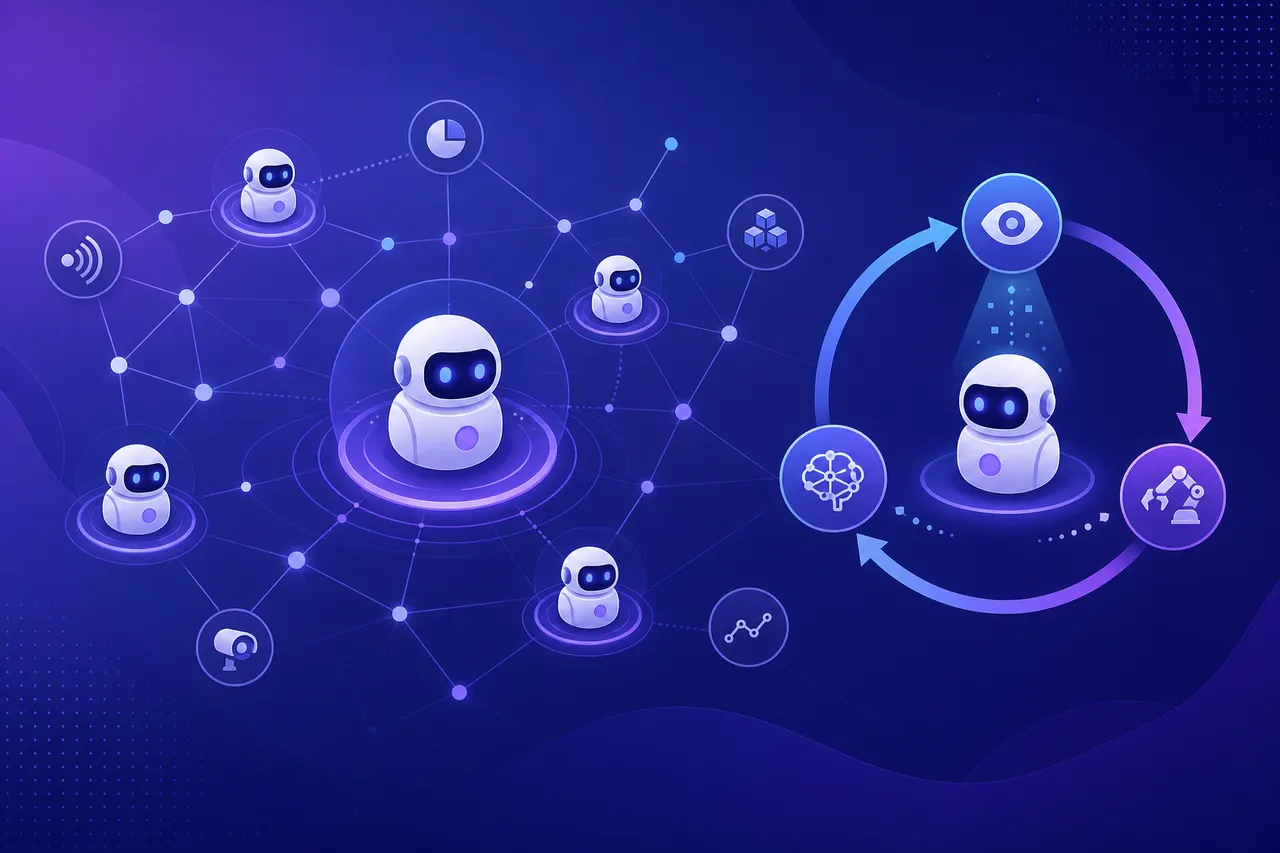
An AI agent is a software entity that perceives its environment through sensors or data inputs, reasons about what it observes, and takes actions to achieve goals. Unlike a fixed program, an agent operates with some degree of autonomy: it can decide what to do next based on its current state, past experience, and objectives. Agents range from simple rule-based bots to complex learning systems that adapt over time.
Definition
An AI agent is a software entity that operates autonomously in an environment, using sensors to perceive the world and actuators to take actions.
Types
Reactive Agents
Simple agents that respond directly to current environmental stimuli
Deliberative Agents
Complex agents that plan and reason about future actions
Learning Agents
Agents that improve their performance through experience
Multi-Agent Systems
Systems with multiple interacting agents
Use Cases
- Virtual assistants and chatbots
- Autonomous vehicles
- Smart home systems
- Trading algorithms
- Game-playing AI
Implementation
AI agents typically use a sense-plan-act cycle, where they perceive the environment, plan actions, and execute them.
Relationships
Machine Learning
Agents often use ML for decision making and learning
Robotics
Physical agents that interact with the real world
Natural Language Processing
Enables human-agent communication
Computer Vision
Allows agents to perceive visual information
Dependencies
- Sensors for environmental perception
- Decision-making algorithms
- Actuators for taking actions
- Learning and adaptation mechanisms
In Practice
In real systems, an agent runs a perceive-think-act loop continuously. It gathers observations, updates its internal model of the world, selects an action using a policy or set of rules, and then measures the outcome. Well-designed agents make this loop fast, reliable, and observable so engineers can debug behavior and improve decision quality.
Key Points
- Agents operate autonomously in environments
- They can learn and adapt over time
- Multi-agent systems enable complex behaviors
- Ethical considerations are crucial for deployment
References
- AI Agents Overview — IBM’s comprehensive guide to AI agents